

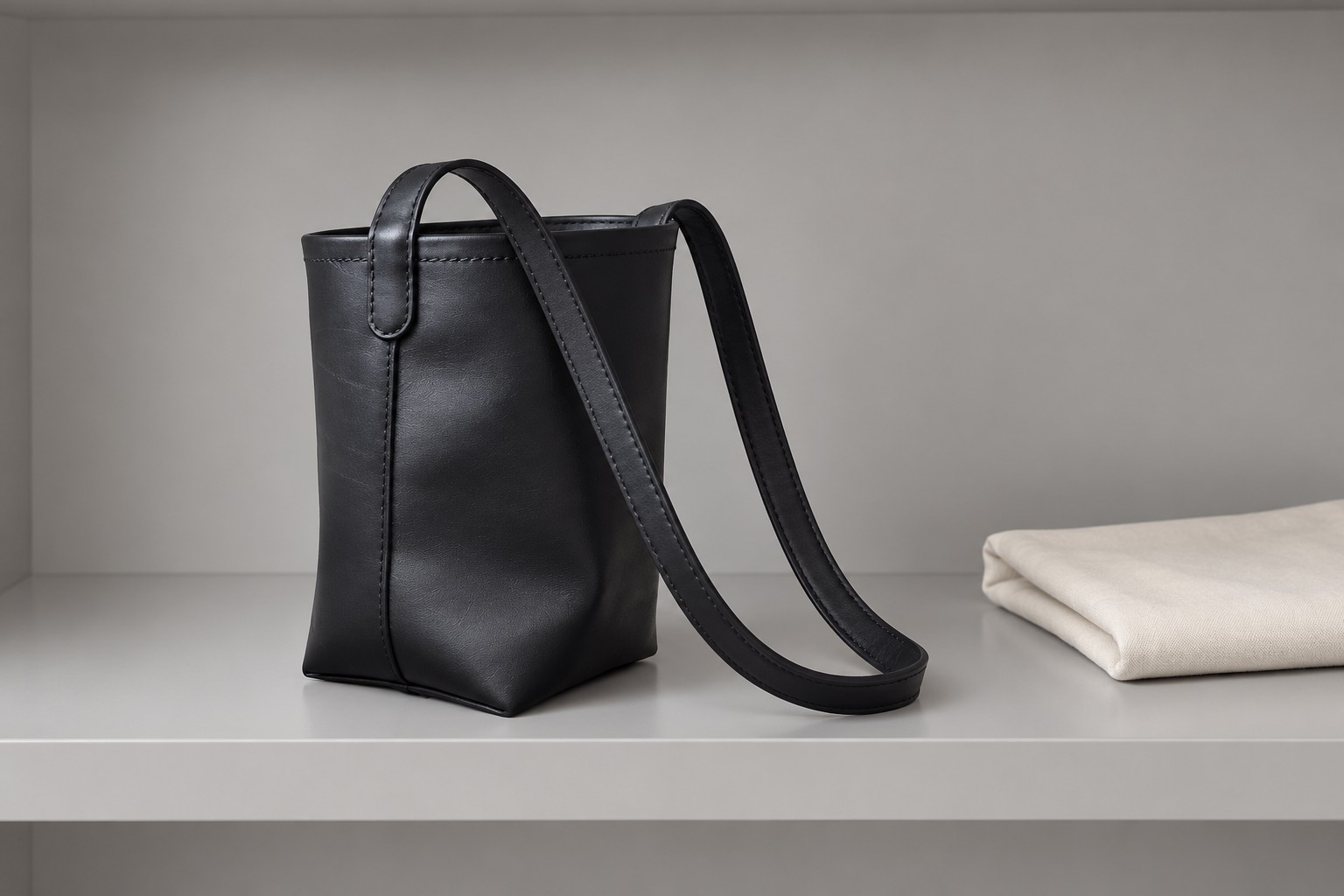
To store leather handbags at home, empty them, support their natural shape, and protect them from dust in a suitable fabric pouch. Choose a shelf away from direct sunlight, heat, and damp conditions, with enough room for each bag to rest without being compressed.
A useful storage arrangement makes it easy to put a bag away carefully and find it again. These principles are a starting point for smooth leather handbags; follow the care instructions for your particular bag and finish whenever they differ.
Empty the bag before putting it away
Remove your everyday belongings, including anything left in pockets. Check for an uncapped pen, a loose cosmetic, or an old receipt before returning the bag to its shelf. Take out heavier items rather than leaving them inside between uses.
This is also a good moment to look at the lining and corners. If you find a mark, check the care guidance before attempting to treat it. Applying a cleaner simply because it is labelled for leather does not establish that it suits your bag’s finish.
Support the shape gently
Use a small amount of loosely arranged, unbuffered acid-free tissue paper to support a bag that would otherwise collapse. Add enough to hold its usual outline, without stretching the sides or pushing against the opening. Avoid newspaper and printed paper in contact with the lining or leather.
The Canadian Conservation Institute’s guidance on leather storage emphasises physical support and recommends unbuffered acid-free tissue for padding. For a handbag at home, the practical aim is gentle support, with no forced folds or pressure points.
Protect from dust without sealing the bag in plastic
Use the dust pouch recommended for your bag, or a suitable clean, soft fabric pouch that allows air to circulate. The pouch should have room around the bag rather than pulling tightly across its corners. Avoid sealed plastic bags for long-term storage.
If several bags share a shelf, leave space between them. A protective pouch is useful, but it does not make it a good idea to squeeze bags into a crowded compartment or stack other objects on top.
Give the body and strap their own space
For a bag designed to stand upright, support its base on a level shelf. Avoid leaving it suspended from its handle or shoulder strap for long periods. Arrange a long strap in a relaxed curve, without a tight fold or knot.
If your bag has a chain or other hardware, keep it from pressing against the leather during storage. Soft tissue can act as a separator where appropriate. Before closing the pouch, check that the strap is resting freely and that nothing heavy is lying across the bag.
Choose the location carefully
Look beyond how the shelf appears. A sunny window, a nearby radiator, or a damp corner can make an attractive display unsuitable for storage. Choose an indoor space with reasonably stable conditions and airflow, away from direct light and heat.
The Canadian Conservation Institute identifies light, extremes of humidity, and nearby heat sources as risks to leather. A wardrobe shelf away from these conditions is a more useful starting point than an exposed windowsill.
Make the routine easy to repeat
Keep the pouch and suitable tissue near the place where the bag is stored. Each time you put it away, check that it is empty, supported, and free from pressure. When returning a bag to use, remove the filling and look over the surface and lining before packing it.
For advice about the appropriate storage or care of your Vard Atelier bag, contact us with the model name and your question. For ideas on what to wear with Ani and The Tote, read One Wardrobe, Two Silhouettes.